
If you or a loved one relies on a wheelchair, knowing how to use a wheelchair van lift properly is essential for safe, independent, and stress-free travel. These lifts—commonly found on accessible vehicles equipped with BraunAbility systems like the Century 2, Millennium 2, or Vista 2—function like compact elevators, smoothly raising and lowering a person in their mobility device from ground level to the vehicle floor. Unlike ramps, they offer a level boarding experience, eliminating the need to navigate inclines that can be physically taxing or unsafe.
Whether you’re a caregiver, driver, or independent user, mastering the correct operation, safety checks, and emergency procedures ensures confidence and peace of mind. This guide walks you through every step of loading, unloading, stowing, and maintaining a wheelchair van lift, using manufacturer-approved practices. You’ll also learn how to respond to power failures, secure passengers safely, and keep your lift in top working condition—all based on real-world use and BraunAbility’s technical guidelines.
Essential Pre-Use Safety Checks
Before operating the lift, always conduct a thorough inspection to prevent accidents and ensure smooth performance.
Confirm Vehicle Safety Settings
- Engage the parking brake to prevent unintended movement
- Park on level ground—slopes can destabilize the lift or cause misalignment
- Ensure the transmission is in “Park”
- Turn off engine if required—some models allow operation with engine off, but verify your system’s requirements
⚠️ Never operate the lift while the vehicle is moving or on an incline.
Inspect the Lift Area
- Clear all obstacles and bystanders from the lift path
- Fully open and secure side or rear doors
- Check for visible damage: bent arms, hydraulic leaks, frayed wires, or worn barriers
- Verify warning labels are legible and intact
- Confirm the control pendant is present and undamaged
✅ Pro Tip: Run the lift at least once per week—even if unused—to prevent hydraulic stiffness and seal degradation.
Understand Key Safety Systems
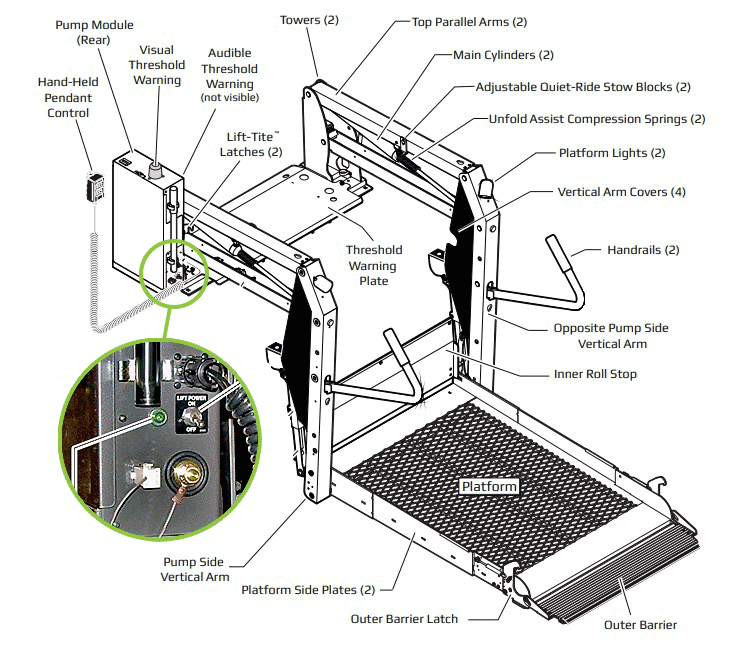
Modern wheelchair van lifts come with multiple built-in safety features designed to prevent accidents and ensure reliable operation.
Automatic Inner Barrier
- Deploys horizontally when the platform unfolds
- Bridges the gap between the lift and vehicle floor
- Equipped with a threshold warning plate that detects weight
- If weight is detected during deployment, the lift will not move and triggers audible and visual alarms
Outer Barrier and Auto Roll Stop
- Acts as a ramp from ground to platform
- Locks into place before the platform begins to rise
- Auto roll stop deploys automatically when the platform touches the ground, preventing rearward movement of the wheelchair
Restraint Belt and Handrails
- A handrail restraint belt prevents the wheelchair from rolling too far back during operation
- Always instruct passengers to hold the handrails for stability
- Ensure the belt is fastened securely before lifting
Interlock System
The lift will not operate unless:
– Parking brake is engaged
– Transmission is in “Park”
– Inner barrier is upright and unobstructed
These interlocks are critical fail-safes—never bypass or disable them.
How to Unload a Passenger Safely
Follow these steps to lower a passenger from the van to ground level with confidence.
Step 1: Prepare the Lift
- Confirm the green power light is on at the pump module
- Step clear of the lift zone
- Press and hold “Unfold” on the control pendant
- The platform extends outward
- Inner barrier deploys automatically
❗ If the platform doesn’t move, press “Fold” briefly to release Lift-Tite latches, then retry “Unfold.”
Step 2: Verify Platform Position
- Confirm inner barrier rests flat on the vehicle floor
- Outer barrier is fully upright and locked
- No obstructions under or around the platform
Step 3: Secure the Passenger
- Engage wheelchair brakes (or power off motorized chairs)
- Buckle the handrail restraint belt
- Instruct passenger to hold handrails
- Position wheelchair within yellow boundary lines, centered for balance
✅ Recommended: Passenger faces outward for better visibility and stability.
Step 4: Lower the Platform
- Press and hold “Down” on the pendant
- Platform lowers slowly and smoothly
- Outer barrier unfolds fully upon reaching ground level
Step 5: Exit the Platform
- Once motion stops:
- Unbuckle restraint belt
- Unlock wheelchair brakes or power on
- Assist passenger to exit safely
🔄 Pro Tip: Always face the lift while operating—never turn your back.
How to Load a Passenger into the Van
Reverse the process to bring a passenger safely onboard.
Step 1: Start at Ground Level
- Ensure platform is fully lowered, outer barrier extended
- Clear area of people, bags, and obstacles
Step 2: Board the Platform
- Guide passenger onto platform
- Ensure wheelchair is:
- Within yellow boundary lines
- Brakes engaged or power off
- Centered for balance
Step 3: Secure for Lift
- Buckle handrail restraint belt
- Confirm passenger holds handrails
- Operator steps clear of lift path
Step 4: Raise the Platform
- Press and hold “Up” on pendant
- Outer barrier rotates upright and locks
- Platform ascends smoothly
- Inner barrier deploys automatically at vehicle level
🚫 Never reach into the lift zone during operation.
Step 5: Enter the Vehicle
- Once platform stops:
- Re-engage power or release brakes as needed
- Guide passenger into the van
- Remove restraint belt
📏 Weight Limit: Max 800 lbs (side-entry) or 1,000 lbs (rear-entry)—include passenger, chair, and cargo.
Storing the Lift After Use
Always fully stow the lift before driving to avoid damage and ensure safety.
Step 1: Clear the Lift Zone
- Ensure no one is on or near the platform
- Remove any bags, oxygen tanks, or equipment
Step 2: Fold the Platform
- Unbuckle restraint belt
- Press and hold “Fold” until platform retracts completely
- Listen for mechanical stop—do not release early
Step 3: Secure the Vehicle
- Close and latch doors
- Confirm lift is flush with vehicle body
- Use pump module indicator to verify stowed position
🔁 For ground-level return: Press “Up” to raise, then “Fold” to stow.
Manual Backup Operation (Power Failure)
If the lift loses power, use the manual system to operate it safely.
Locate Backup Components
- Pump handle: Stored in clips on pump module
- Manual backup pump: Inside pump housing
- Release valve: Below pump receptacle (slotted head)
Manual Unloading Steps
- Open vehicle doors and clear area
- Close release valve:
– Insert pump handle into valve
– Turn clockwise to close - Pump handle up/down to:
– Release Lift-Tite latches
– Allow platform to unfold - Open valve (½ turn counterclockwise)—platform lowers slowly
- Close valve once on ground
- Secure passenger, unbuckle belt, assist off
⚠️ Only trained individuals should perform manual operation.
Manual Raising and Stowing
- Close release valve (clockwise)
- Insert pump handle into backup pump
- Pump repeatedly until platform reaches vehicle level
- Continue pumping to fully fold and stow
- Keep valve closed for automatic function when power returns
- Return handle to storage clips
🛑 Warning: Do not leave valve open—this disables automatic operation.
Lubrication and Routine Maintenance
Proper care extends lift life and prevents failures.
Lubricate Every 750 Cycles
- Clean moving parts—remove dirt, salt, debris
- Apply light penetrating oil to:
– Pivot joints
– Hinges
– Lift arms
– Barrier locks - Operate lift 2–3 times to distribute lubricant
📅 Schedule maintenance based on cycle counter (on pump module top).
Weekly Operation Tip
Even if unused, run the lift once per week:
– Prevents hydraulic fluid settling
– Keeps seals pliable
– Reduces risk of startup failure
Inspection Checklist
During maintenance, check:
– Hydraulic hoses – leaks, cracks, bulges
– Electrical connections – fraying, corrosion
– Control pendant – button responsiveness
– Platform surface – worn yellow boundary lines
– Barriers and latches – secure locking
🛠️ Replace damaged parts immediately. Contact BraunAbility Support (1-800-843-5438) for OEM parts.
Securing the Wheelchair Inside the Van
Lift operation ends—but safety continues during transit.
Use a Tie-Down System
- Face wheelchair forward (best for crash protection)
- Attach four-point tie-down straps to:
– Frame anchors (never wheels or footrests) - Tighten all straps
- Confirm no movement when pushed side-to-side
Secure the Passenger
- Use lap and diagonal chest belt
- Ensure snug fit across hips and shoulder
- Never rely on wheelchair brakes alone
✅ Best practice: Transfer to vehicle seat and use standard seat belt when possible.
Troubleshooting Common Issues
Quick fixes for frequent problems.
Platform Won’t Unfold
- Cause: Lift-Tite latches engaged
- Fix: Press “Fold” briefly, then retry “Unfold”
Slow or Jerky Movement
- Cause: Low hydraulic fluid or lack of lubrication
- Fix: Top off fluid (by technician), lubricate joints
No Response from Controls
- Check:
- On/off switch at pump module
- Green power light
- Vehicle power and fuses
- Try manual backup if safe
Alarm or Warning Light
- Refer to manual for error codes
- Common triggers: barrier obstruction, weight on threshold
- Clear issue, reset system
📞 Call BraunAbility Support for remote diagnostics or service referrals.
Training and Independent Use
For Caregivers and Drivers
- Read the operator’s manual thoroughly
- Receive in-person training from dealer or rehab specialist
- Practice manual backup procedures
- Track cycle count for maintenance
For Independent Users
- Use handlebar control buttons (if equipped) for self-operation
- Install Auto Six-Way Base for driver transfers
- Always confirm lift is fully stowed before driving
🎯 Pro Tip: Record a short video of your first few operations to review technique.
When to Choose a Lift vs. a Ramp
| Scenario | Best Option |
|---|---|
| Heavy scooters or power chairs | Lift |
| Users with limited upper strength | Lift |
| Frequent multi-passenger transport | Lift |
| Need fast boarding | Ramp |
| Walkers or canes (no wheelchair) | Ramp |
While ramps are faster, lifts offer greater safety and automation for heavier mobility devices.
Final Safety Reminders
- ✅ Always use level ground
- ✅ Engage parking brake every time
- ✅ Inspect before each use
- ✅ Lubricate every 750 cycles
- ✅ Secure passenger and wheelchair after entry
- ✅ Keep manual backup tools accessible
- ✅ Never skip training
Contact BraunAbility: 1-800-843-5438
Keep model and serial numbers handy (found on pump and tower ID tags)
Conclusion: Knowing how to use a wheelchair van lift properly ensures dignity, independence, and safety for every journey. By following these clear, step-by-step procedures—from pre-checks to securement—you’ll maximize reliability and confidence. Whether you’re using the lift daily or occasionally, regular maintenance and adherence to safety systems make all the difference. Stay informed, stay trained, and travel with peace of mind.