
For millions of Americans who rely on wheelchairs or mobility scooters, the ability to travel independently hinges on one essential component: a dependable wheelchair lift for vehicles. Without it, simple errands or family trips can turn into logistical nightmares. Fortunately, today’s market offers a wide range of types of wheelchair lifts for vehicles, each designed to meet different mobility needs, lifestyles, and vehicle types.
From compact micro lifts for sedans to full under-vehicle systems in converted vans, there’s a solution for nearly every situation. The key is understanding how each type works, where it installs, and who benefits most. Whether you’re a scooter user who transfers easily or a full-time wheelchair rider who needs to stay seated during entry, this guide breaks down every major category—exterior, interior, and hybrid lifts—with real-world performance, safety features, compatibility, and cost insights from top manufacturers like Bruno, BraunAbility, and Harmar.
By the end, you’ll know exactly which type of wheelchair lift for your vehicle aligns with your independence goals, daily routine, and budget.
Exterior Wheelchair Lifts: Preserve Space, Maximize Independence
Exterior lifts mount outside the vehicle and are ideal for users who can transfer from their wheelchair. These systems keep the interior completely open for passengers and cargo while offering powered, remote-controlled loading.
Hitch-Mounted Lifts: Best for SUVs, Vans, and Trucks
Hitch-mounted lifts are among the most popular exterior options, attaching directly to a Class III or IV trailer hitch. Models like the Bruno Out-Sider 3 and Harmar AL500 support up to 450 lbs—enough for most scooters and manual wheelchairs.
These lifts lower to ground level, allowing you to drive or roll your mobility device directly onto the platform. With a simple press of a remote, the lift raises and stows the device behind the vehicle. Many include a swing-away feature, which pivots the lift sideways so you can still open your rear hatch or tailgate.
Pro tip: If you own multiple compatible vehicles, hitch-mounted lifts can often be transferred—making them a flexible, long-term investment.
Bumper-Mounted Lifts: A Solution When No Hitch Exists
For vehicles without a trailer hitch, bumper-mounted lifts offer an alternative. These systems attach directly to the rear frame or bumper and are typically installed professionally to ensure structural integrity.
While less common due to concerns about long-term frame stress, they provide a functional option for sedans or older models. However, they lack the portability of hitch models and are generally fixed in place.
Micro Exterior Lifts: Perfect for Sedans and Compact Cars
Don’t drive an SUV? No problem. Micro exterior lifts like the Bruno Smart Lifter LC are engineered for smaller vehicles. These lightweight systems support up to 220 lbs and work with folding manual wheelchairs or travel scooters.
Some models deploy vertically from inside the trunk, while others attach to a hitch. Their compact design means they don’t affect aerodynamics or appearance. Plus, many are removable when not in use—ideal for shared or multi-purpose vehicles.
Under-Vehicle Lifts (UVL): Hidden Power for Full-Size Vans
The BraunAbility UVL® and UVL855 represent the gold standard in exterior lift design. These under-vehicle lifts (UVL) are fully concealed beneath the chassis when not in use. When activated, the platform silently extends downward and outward to ground level.
Once loaded, the lift retracts completely under the vehicle, leaving the rear doorway unobstructed. This makes UVLs ideal for full-size vans used in family transport or commercial fleets.
Key benefit: No loss of interior space, full weather protection, and a clean, factory-like look.
However, UVLs require regular maintenance—especially in snowy climates—to prevent corrosion from road salt and debris buildup.
Interior Wheelchair Lifts: Full Accessibility for Non-Transfer Users
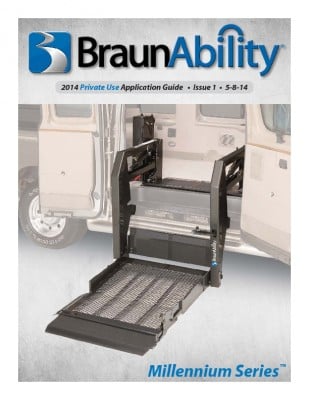
Interior lifts allow users to remain seated in their wheelchair while being lifted into the vehicle. These are essential for individuals who cannot transfer and are typically part of a full wheelchair-accessible vehicle (WAV) conversion.
Platform Lifts: Seamless Curb-Level Access
Interior platform lifts, like the BraunAbility Millennium Series™ and Century Series™, lower to curb height so you can roll directly into the vehicle. Found in side- or rear-entry minivans and full-size vans, they integrate with lowered floors and ramps for a smooth, step-free ride.
The platform folds or splits when not in use, allowing others to enter and exit freely. These systems are fully automatic and controlled via remote, making them ideal for independent travel.
Ideal for: Users who need to stay in their wheelchair and value full accessibility.
Dual-Post vs. Single-Post Lifts: Stability vs. Space
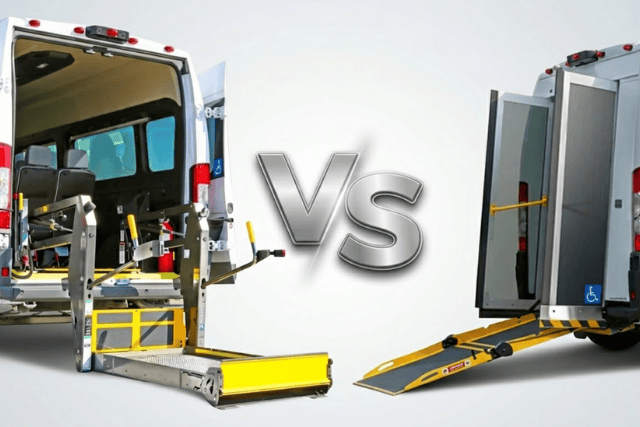
In full-size vans (Ford Transit, Ram ProMaster), two main types dominate:
- Dual-Post Lifts: Use two hydraulic arms for maximum stability—perfect for heavy power chairs (up to 750 lbs).
- Single-Post Split-Platform Lifts: Feature one central post with a split platform that retracts fully, maximizing doorway clearance.
Both are reliable and user-friendly, but dual-post systems are preferred for larger, heavier mobility devices.
Hoist-Style Interior Lifts: Powered Scooter Storage
Not all interior lifts carry the user. Hoist-style lifts, such as the Bruno Smart Lifter, use a crane-like arm to lift scooters or folded wheelchairs into the cargo area.
Common in SUVs and minivans, these systems let you transfer into the driver’s seat first, then store your device automatically. While not suitable for non-transfer users, they offer fast, weather-protected loading without manual lifting.
Hybrid Interior/Exterior Lifts: The Best of Both Worlds
Hybrid lifts combine the convenience of powered loading with full interior protection. Installed in the cargo area, they extend outside to ground level, allowing drive-on access. After lifting, the platform rotates or slides inside the vehicle.
This design keeps your mobility device safe from rain, snow, and theft while eliminating manual lifting. It’s faster than a hoist and more discreet than a traditional exterior lift.
Best for: SUV and minivan owners who want convenience and protection without sacrificing too much cargo space.
Vehicle-Specific Lift Options: Matching Lift to Ride
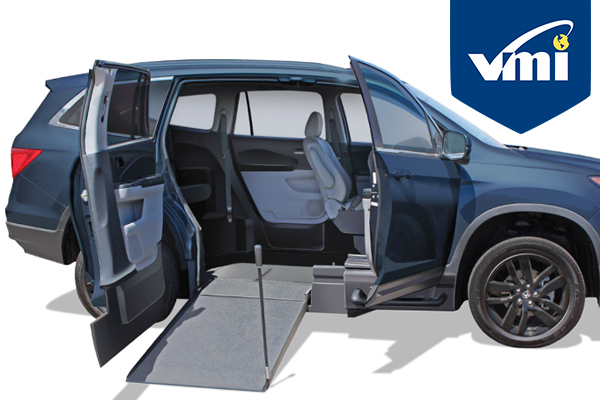
Not all lifts fit all vehicles. Ground clearance, door size, and structural design determine compatibility.
Minivan Wheelchair Lifts
Minivans are the top choice for interior accessibility. Side-entry conversions allow wheelchair users to sit in the front passenger seat, maintaining eye-level conversation during travel.
Full conversions include floor lowering, ramp integration, and either platform lifts or hoist systems. Leading models include BraunAbility Edge, Millennium, and Bruno Revue.
SUV & Crossover Lifts
Higher ground clearance limits interior lift options. Most SUVs use:
– Hitch-mounted exterior lifts (e.g., Bruno Out-Sider)
– Interior hoists for scooter storage
– Hybrid lifts in larger models (e.g., Honda Pilot, Chevrolet Traverse)
These preserve seating and offer independence for active users.
Pickup Truck Wheelchair Lifts
Truck owners aren’t left out. Specialized lifts raise mobility devices into the bed or behind the cab.
Options include:
– Bed Platform Lifts: Raise chair/scooter into the bed
– Tailgate Lifts: Attach to tailgate and lift vertically
– Side-Mount Hoists: Swing device into bed from the side
Models like the Bruno TC100 and Harmar TL7500 support up to 750 lbs. Optional AccessATop covers provide weather protection.
Perfect for: Active users who want to maintain a truck lifestyle.
Full-Size Van & RV Lifts
Large vans (Ford Transit, Mercedes Sprinter) support heavy-duty systems like UVLs and dual-post interior lifts. They’re used in family transport, paratransit, and medical fleets.
RVs and motorcoaches use ADA-compliant lifts like the BraunAbility NL500 and NUVL855, operated by attendants with safety sensors and roll stops.
Device Compatibility and Weight Limits
Always match the lift to your mobility device.
Supported Devices:
- Manual & power wheelchairs
- 3-wheel & 4-wheel scooters
- Travel/folding models
Critical check: Ensure the platform fits your chair’s width and wheelbase.
Weight Capacity by Lift Type:
| Lift Type | Max Weight |
|---|---|
| Micro Lifts | 220 lbs |
| Hitch Scooter Lifts | 350–450 lbs |
| Full-Size Van Lifts | 600–750 lbs |
| Truck Lifts | 500–750 lbs |
| ADA Commercial Lifts | 600+ lbs |
Choose a lift rated 10–20% above your device’s weight for safety and longevity.
Safety Features You Can’t Ignore
Modern lifts include:
– Obstacle detection sensors
– Non-slip surfaces
– Automatic locking
– Manual backup systems
– Tie-down points
– Roll stops (ADA models)
These are standard on reputable brands and required for commercial certification.
How to Choose the Right Lift
Ask:
– Can you transfer? → Yes: exterior/hoist; No: interior/hybrid
– What’s your vehicle? → Sedan: micro; SUV: hitch/hybrid; Van: interior/UVL
– Weather protection needed? → Yes: interior, hybrid, or covered exterior
– Budget? → Under $5K: hitch/micro; $5K–$10K: hybrid/truck; $10K+: interior/WAV
Final Thoughts
The right type of wheelchair lift for vehicles empowers independence. Exterior lifts offer affordability and space savings. Interior and hybrid systems provide full accessibility and protection. With the right fit, you’re not just buying a lift—you’re reclaiming your freedom to go anywhere, anytime.