
Getting a wheelchair user up or down stairs is one of the most physically demanding and risky mobility tasks. Without ramps, lifts, or elevators, knowing how to bump a wheelchair up stairs safely becomes essential—especially in homes, emergencies, or temporary environments. While manual techniques should never be the first choice, they are sometimes unavoidable. This guide delivers a clear, step-by-step breakdown of the two-person assist method, the only recommended manual technique, along with safer equipment alternatives and critical safety rules.
If you’re facing a staircase with a wheelchair, your priority must be safety—for both the user and helpers. A single misstep can cause serious injury, equipment damage, or loss of independence. Whether you’re a caregiver, family member, or wheelchair user yourself, understanding the right way to navigate stairs manually—and when to avoid it altogether—can make all the difference.
Two-Person Assist: The Only Safe Manual Method

When no equipment is available, the two-person assist is the gold standard for moving a wheelchair up or down stairs. Recommended by rehabilitation centers like Craig Hospital and supported by occupational therapy guidelines, this technique ensures better balance, reduces caregiver strain, and maintains control throughout the process.
Prepare Before You Start
Before attempting any stair movement, take time to set up for success.
- Engage wheelchair brakes at the bottom and top.
- Remove anti-tippers—these safety bars can catch on steps and cause tipping.
- Clear accessories like bags, oxygen tanks, or trays that could snag.
- Ensure the user is seated securely, feet on footrests, hands off wheels.
- Use a seatbelt if available to prevent forward sliding.
- Wear non-slip shoes and inspect stairs for hazards like moisture or loose carpet.
⚠️ Critical Reminder: Never attempt stair navigation with anti-tippers attached. They prevent tipping on flat ground—but become dangerous obstacles on stairs.
Ascend Stairs: Back and Front Roles

Climbing up requires synchronized effort. The rear caregiver provides power, while the front caregiver guides and stabilizes.
Back Caregiver (Rear Spotter)
- Stands behind the chair, gripping the push handles.
- Uses leg strength, not back, to lift.
- Keeps knees bent, back straight, and core engaged.
Front Caregiver (Front Spotter)
- Positions one or two steps up, facing the chair.
- Grips the frame near the footrests, never the footrests themselves.
- Guides and stabilizes the chair upward.
Step-by-Step: Ascending Stairs
- Back the wheelchair until rear wheels touch the first step.
- Both caregivers adopt a stable, wide stance, knees bent.
- Tilt chair slightly backward to shift weight onto rear wheels.
- Use synchronized verbal cues:
– “Ready?” – Both confirm positioning.
– “Dip” – User (if able) leans forward slightly to pass the balance point.
– “Pull” – Both lift together in one smooth motion. - After each step:
– Front caregiver presses down on frame and says “Holding”.
– Rear caregiver steps up and repositions. - Repeat:
Ready? Ready? Dip. Pull. Holding.
Continue until the top is reached.
💡 Pro Tip: The rear caregiver should kneel or squat on the top step while lifting. This lowers your center of gravity and protects your back.
- At the top:
– Back wheelchair away from edge.
– Tilt forward gently until front casters rest flat.
– Re-engage brakes.
– Reattach anti-tippers and accessories.
Descend Stairs: Controlled Lowering
Going down is more dangerous—gravity increases the risk of forward tipping. Control is everything.
Back Caregiver (Rear Spotter)
- Stands behind, one foot under the chair, one behind.
- Maintains backward tilt to prevent forward roll.
- Controls descent speed with leg strength.
Front Caregiver (Front Spotter)
- Stands two steps below in a stride stance.
- Holds the frame to guide and stop forward movement.
- Presses down to stabilize after each step.
Step-by-Step: Descending Stairs
- Start with wheelchair sideways to stairs, brakes on.
- Remove anti-tippers and accessories.
- Verbal sequence:
– “Ready?” – Confirm readiness.
– “Lower” – Both lower chair slowly down one step. - After each step:
– Front caregiver presses down on frame and says “Holding”.
– Rear caregiver repositions—foot under chair, other foot back. -
Repeat:
Ready? Ready? Lower. Holding.
Continue until the bottom is reached. -
At the bottom:
– Turn chair sideways.
– Engage brakes.
– Reinstall anti-tippers.
🛑 Never grip footrests. They are not designed to bear weight and can snap under pressure.
One-Person Technique: Last Resort Only
When only one helper is available, this method should be used only for 1–3 steps and only if the caregiver is strong and trained.
How to Perform a One-Person Bump Up
- Position wheelchair facing backward toward the stairs.
- Tilt so rear wheels rest against the first step.
- Grip push handles firmly, keep back straight, knees bent.
- Pull upward and backward using leg strength, lifting front casters onto the first step.
- Rock slightly forward to bring rear wheels up.
- Repeat one step at a time.
⚠️ Limitations:
– High risk of back injury.
– Not safe for full flights.
– Requires significant strength.
– Only attempt if the user can assist slightly.🚫 Avoid this method if the user has poor trunk control or the stairs are steep, narrow, or slippery.
Equipment Over Manual: Safer Alternatives
Manual stair navigation should be a last resort. Whenever possible, use assistive devices that eliminate risk and promote independence.
Use Portable Ramps for Occasional Access
For visiting homes or short-term use, portable ramps are affordable and effective.
Types:
- Foldable ramps: Lightweight aluminum, easy to carry.
- Telescoping ramps: Extend to fit different heights.
- Modular ramps: Interlocking sections for semi-permanent outdoor use.
Key Features:
- Non-slip surface
- Weight capacity: 600–800 lbs
- ADA-compliant slope (1:12 ratio recommended)
✅ Best for: 1–3 steps, visiting family, temporary access
❌ Not for: Steep or long staircases
Install Permanent Ramps for Long-Term Use
Custom-built ramps offer full accessibility and eliminate manual lifting.
- Materials: Wood, aluminum, or concrete.
- Must include handrails, edge guards, and non-slip surfaces.
- Follow ADA standards:
- Slope ≤ 1:12 (1 inch rise per 12 inches run)
- Width ≥ 36 inches
- Landings every 30 feet and at top/bottom
💡 Note: Permits may be required. Ideal for aging in place or frequent stair access.
Consider Stair Lifts for Independent Users
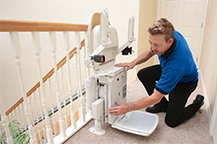
A stair lift (or chair lift) allows users to ride a motorized seat up and down stairs.
How It Works:
- User transfers from wheelchair to lift seat.
- Operates via remote or wall switch.
- Folds when not in use.
- Battery backup ensures function during outages.
Installation:
- Professional setup required.
- Available in straight or curved models.
✅ Best for: Users who can transfer independently
💰 Cost: $2,500–$10,000 depending on staircase complexity
Platform Lifts: For Wheelchair-Bound Users
When transferring isn’t possible, platform lifts carry the entire wheelchair and user.
Types:
- Vertical Platform Lifts (VPLs): Move straight up/down—ideal for tight spaces.
- Inclined Platform Lifts: Travel along the staircase rail with the wheelchair onboard.
✅ Best for: Users who cannot stand or transfer
🏠 Installation: Requires structural modifications; permits often needed
Invest in Stair-Climbing Wheelchairs
For full independence, consider advanced wheelchairs designed to climb stairs autonomously.
Top Models:
| Model | Features | Price Range |
|---|---|---|
| Scewo BRO | Self-balancing, track system, app control | $40,000+ |
| TopChair-S | All-terrain, foldable, stair-climbing | $10,000–$15,000 |
| Seedee Wheelchair | Affordable stair-climbing option | $5,000–$8,000 |
✅ Benefits:
– No manual lifting
– Full user control
– Indoor and outdoor use❌ Drawbacks:
– High cost
– Heavy and complex to maintain
– Limited availability
Safety Rules You Must Follow
Even with perfect technique, accidents happen when safety is ignored. Follow these non-negotiable rules.
Use Proper Lifting Form
- Bend knees, not back.
- Keep spine neutral and core tight.
- Lift with leg muscles—never twist or jerk.
Communicate with Verbal Cues
Standardized commands prevent missteps:
– “Ready?” – Confirm positioning
– “Pull” – Lift upward
– “Lower” – Descend slowly
– “Holding” – Chair is stable
💬 Tip: Practice the sequence on flat ground first.
Never Do These Risky Actions
| Dangerous Practice | Why It’s Unsafe |
|---|---|
| Gripping footrests during lift | Footrests can detach, causing collapse |
| Attempting full flights alone | High risk of back injury and loss of control |
| Using plywood or makeshift ramps | No grip or structural support |
| Untrained helpers assisting | Lack of coordination increases fall risk |
🚫 Rule of Thumb: If the staircase has more than 3–4 steps, don’t attempt manual transfer without training or equipment.
When to Avoid Manual Stair Navigation
There are clear red flags that mean you should not attempt to bump a wheelchair up or down stairs:
- More than 3–4 steps
- Narrow, spiral, or steep stairs
- Wet, icy, or uneven surfaces
- Caregiver has back issues or low strength
- User has poor trunk control or spinal instability
- No handrails or secure footing
🔔 Better option: Rearrange living space to first floor or install a lift.
Respect User Dignity and Autonomy
Many wheelchair users prefer alternatives to being lifted like furniture.
🗣️ “I’d rather bum scoot up and have someone bring the chair after me.” – musicalearnightingal
🗣️ “I do it myself in emergencies. I don’t want to be treated like cargo.” – wheeledECOwarrior
Best Practices:
- Ask first: “How do you prefer to handle stairs?”
- Respect their choice: Scooting, equipment, or assistance.
- Maintain eye contact and talk directly to the user.
- Never assume help is needed.
✅ Golden Rule: The person in the wheelchair is in charge of their body.
Get Professional Help When Needed
Don’t rely on guesswork. Occupational therapists and home assessors can provide life-changing guidance.
Consult an Occupational Therapist (OT)
An OT can:
– Evaluate home accessibility.
– Train caregivers in safe transfer techniques.
– Recommend ramps, lifts, or adaptive equipment.
– Create personalized mobility plans.
✅ Tip: Ask your doctor for a referral. Medicare and insurance may cover assessments.
Final Tips for Safe Stair Navigation
- Never rush. Take your time—safety over speed.
- Train all helpers. Use consistent commands and roles.
- Inspect equipment regularly. Check ramps, lifts, and wheelchair integrity.
- Prioritize equipment over manual lifting. Ramps and lifts eliminate risk.
- Respect the user’s choice. Dignity is as important as safety.
- Plan ahead. Assess stairs, weather, and physical readiness.
✅ Bottom Line: Stairs don’t have to limit mobility. With the right technique, tools, and respect, you can navigate vertical challenges safely—without compromising independence or safety.