
Imagine standing at the water’s edge, toes buried in warm sand, waves lapping just feet away—except you use a wheelchair. Standard models sink immediately into soft sand, leaving you stranded on the shoreline while others enjoy the surf. For millions with mobility challenges, this moment of exclusion is heartbreaking. But there’s a powerful solution: how to make a beach wheelchair at home for under $300. Commercial versions cost upwards of $1,000 and are rarely available when needed. DIY builds using PVC, steel, or repurposed wagons offer affordable, durable access to the beach. This guide walks you through every proven method—balloon tires, PVC frames, steel reinforcements, and cart conversions—so you can build a functional, all-terrain chair that restores independence and joy.
Choose Your Beach Wheelchair Build Type
Before cutting pipe or welding metal, pick the design that fits your needs, tools, and budget.
PVC Beach Wheelchair
Lightweight, inexpensive, and tool-free assembly make this ideal for beginners. Using thick-walled Schedule 80 PVC, the frame snaps together without screws or adhesives. Supports up to 300 lbs when properly built. Perfect for occasional beach trips and easy transport.
Pro Tip: Grey electrical conduit PVC resists UV degradation better than white plumbing-grade pipe.
Steel-Reinforced Wheelchair
Modify an existing manual chair by adding a rugged steel base. Keeps your familiar seat and backrest while replacing weak aluminum legs with load-bearing steel and balloon tires. Requires welding but delivers unmatched durability.
Beach Cart Conversion
Start with an all-terrain wagon—like Harbor Freight’s popular model—and upgrade it with larger wheels and a secure seat. Fast build with minimal fabrication. Some models already have big wheels, but most need wider “balloon” tires to avoid sinking.
Dual Cart Hybrid Design
A creative, stable solution using two foldable beach carts (e.g., from TikTok Shop) linked together. Doubles weight capacity and footprint, ideal for children or users needing extra stability. Fully portable and surprisingly strong.
Build a PVC Beach Wheelchair (Step-by-Step)

This modular design uses Schedule 80 PVC and balloon tires for under $250. No power tools needed—just a hacksaw and measuring tape.
Gather Materials and Tools
Parts List:
– 1¼” Schedule 80 PVC pipes (various lengths)
– PVC fittings: elbows, tees, 4-way, 5-way connectors
– 16″–20″ pneumatic balloon wheels
– 36″ steel axle (¾” or ½” diameter)
– Bearings, lock nuts, washers
– ¾” x 1″ black steel nipples
– Marine-grade mesh seat and backrest
– Hacksaw, measuring tape, marker
Save Money: Check Habitat ReStore, Freecycle, or Craigslist for free or discounted PVC and fittings.
Cut and Prepare PVC Pipes
Cut these standard lengths:
– 3″ (x10), 4″ (x2), 5″ (x8), 7.9″ (x1), 8″ (x3), 15″ (x2), 19.5″–19.8″ (multiple)
Deburr edges for smooth assembly. Label each piece to avoid confusion later.
Assemble the Rear Wheel Base
- Slide two ¾” black steel nipples into the ends of the 36″ axle.
- Add ¾” x 1¼” bushings over each nipple.
- Push 1¼” couplers onto the bushings.
- Insert two 4″ PVC tubes vertically into the couplers.
These uprights will later connect to the side arms.
Construct Side Arms (Make Two)
Each side runs from front to back:
– Connect: 3″ → elbow → 3″ → elbow → 15″ → tee → 5″
– Lay flat to align; the 5″ tube extends upward at the back.
These form the main support rails and connect the front and rear wheel bases.
Install the Front Wheel Assembly
Repeat the axle setup:
– Use second 36″ axle with bearings
– Attach ¾” nipples and bushings
– Connect via a 20.4″ PVC tube with 1″ elbows on both ends
This creates a long, stable frame with dual large wheels.
Build the Bottom Frame
Create a rigid rectangle:
1. Connect two 19.58″ tubes with 5-way and 4-way fittings.
2. Join both sides with 19.48″ crossbars.
3. Attach bushings and ¾” nipples underneath to link to wheel assemblies.
Ensure joints are tight—no wobbling under light pressure.
Add Adjustable Footrest
For comfort and posture:
1. Build two sides: 3″ → elbow → 8″ → 3-way → 5″ → elbow
2. Connect with 19.58″ tubes
3. Mount under front crossbar
Custom Fit: Adjust the 8″ tube length based on user’s leg measurement.
Attach Seat and Backrest
- Insert vertical 5″ PVC tubes into the seat’s 4-way fittings.
- Connect backrest using 19.78″ tubes with elbows.
- Reinforce with 7.9″ and 3″ support rods.
- Secure mesh fabric with zip ties or Velcro.
Ensure seat height allows easy transfer—ideally 19″–21″.
Final Assembly
- Join all subassemblies: wheel bases, side arms, footrest, seat.
- Confirm wheels spin freely and frame sits level.
- Test with increasing weight—start empty, then add load.
Warning: Never leave PVC assembly in direct sunlight—UV exposure weakens plastic over time.
Reinforce a Standard Wheelchair with Steel
Ideal if you already own a manual chair and want beach access.
Why Reinforce?
Aluminum wheelchair frames bend under stress on sand. A steel support base carries the full load, protecting the original frame.
Fabricate the Steel Support Base
Materials:
– 1.5″ x 48″ U-shaped steel bar (backbone)
– ¼” steel crossbars (22 9/16″ long)
– 4.5″ steel brackets for rear leg mounts
Steps:
1. Position U-bar beneath the chair.
2. Cut 4.5″ steel pieces to wrap around rear legs.
3. Grind edges smooth; taper one end into a V for stronger solder bond.
4. Weld or solder brackets to the main bar.
Safety First: Sand all welds smooth to prevent cuts.
Mount Balloon Tires
Wheel Specs:
– 16″–20″ diameter, 3″–6″ wide pneumatic
– Bearings with ½” bore
Installation:
1. Drill ½” hole through steel bracket (start small, enlarge gradually).
2. Insert:
– Bearing
– Custom washer (drilled from larger washer)
– ½” bolt
– Second washer
– Lock washer
– Nut
3. Tighten securely; ensure wheel spins without wobble.
Pro Tip: Custom washers solve mismatched sizes—don’t force fit.
Add a Removable Pull Handle
- Cut 1.5″ PVC pipe to 38.25″.
- Heat center with heat gun and flatten in a vice for grip.
- Drill central hole.
- Attach with removable pin.
User Benefit: Lets caregivers pull the chair easily—detaches for storage.
Future Upgrade: Add Front Casters
Current design lacks front wheels—prone to tipping.
Solution:
– Install two small caster wheels under the front frame.
– Improves balance on dunes and wet sand.
– Enhances steering.
Builder’s Note: “The design isn’t complete—front wheels are next.”
Convert a Beach Cart into a Wheelchair
A smart shortcut using mass-market wagons.
Choose the Right Cart
Look for:
– All-terrain wheels (e.g., Harbor Freight #61989)
– Steel frame
– Foldable design
– High weight capacity (200+ lbs)
Reality Check: Stock wheels often fail in soft sand—upgrade is essential.
Upgrade to Balloon Tires
- Remove original wheels.
- Replace with 16″–20″ beach-specific pneumatic tires.
- Use compatible axles and bearings.
- Reattach with lock nuts.
User Feedback: “The HF wagon still bogged down. Ended up carrying her.” — Alfred-TNT
Modify for Seating
Options:
– Mount a lightweight lawn chair or mesh seat.
– Weld or bolt a custom seat frame.
– Use straps to secure user.
Ensure seat height allows safe transfer (~19″–21″).
Optional: Convert Push Bar to Steering
Replace fixed bar with swivel joint:
– Allows directional control like a stroller.
– Reduces effort on uneven terrain.
Hybrid Dual Cart Design
Innovative solution using two TikTok Shop beach carts.
Why Two Carts?
- Doubles stability and weight distribution
- Built-in large wheels
- Foldable and portable
- Affordable (~$100 each)
Link Carts for a Single Platform
- Align carts side-by-side.
- Connect with steel or PVC crossbars.
- Reinforce joints with brackets.
Creates a wide, low-pressure footprint ideal for soft sand.
Customize for Comfort
- Add supportive backrest
- Install safety harness
- Adjust height for easy transfer
- Include cup holder or storage pouch
Real Use: Built for child #KaleeT18—focused on safety and fun.
Wheel Design: The Key to Sand Mobility
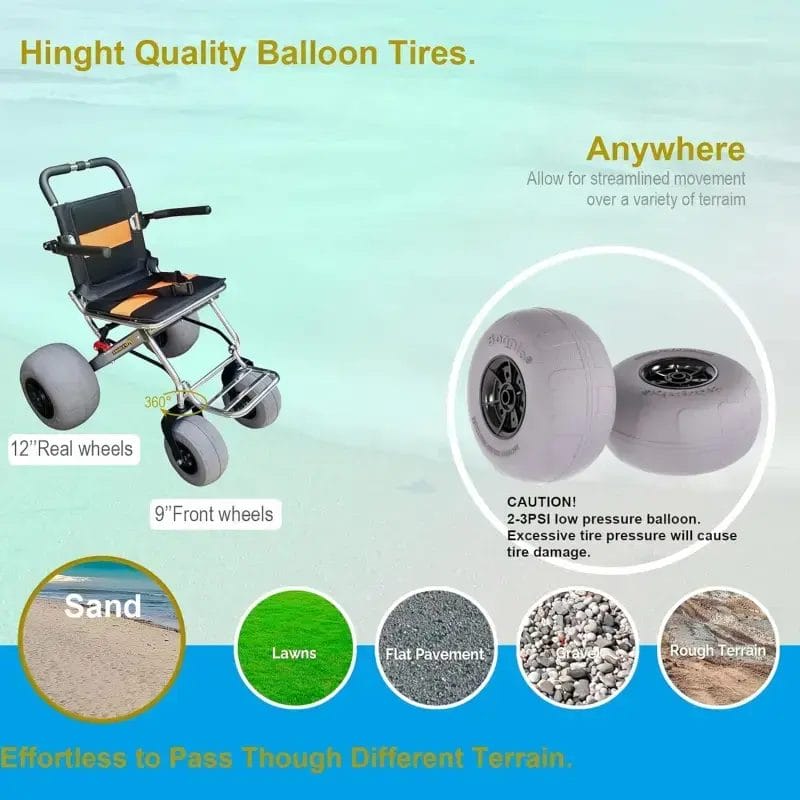
Without proper wheels, no beach chair works.
Why Balloon Tires?
They spread weight over more surface area:
– Standard wheelchair: ~30 psi → sinks
– Balloon tire: ~10–15 psi → floats on sand
Where to Buy
- eBay: Search “beach wheelchair wheels”
- Walmart: Kids’ trikes or utility carts
- Harbor Freight: All-terrain wagon wheels
Axle Requirements
- 36″ steel rod (¾” or ½” diameter)
- Bearings with matching bore
- Lock washers and nuts
DIY Hack: Fabricate adapters if sizes don’t match.
Material Sourcing Tips
PVC Pipe
- Best: Schedule 80 (thicker, stronger)
- Sources: Home Depot, ReStore, Freecycle
- Free Option: Ask city parks departments for scrap
Wheels and Axles
- Budget Pick: Harvest from kids’ trikes
- Best Value: Harbor Freight wagon wheels
- Premium: eBay beach-specific sets
Pro Tip: Fabricate adapters—don’t force fit.
Enhance Comfort and Function
Seat and Backrest
- Use marine-grade mesh—dries fast, resists mold
- Ensure seat depth supports thighs
- Backrest height: mid-chest minimum
Add Accessories
- Clip-on cup holder
- Attachable sunshade
- Waterproof storage pouch
- Adjustable footrests
Safety, Durability, and Maintenance
Protect Against UV Damage
PVC weakens in sunlight.
Prevention:
– Store indoors
– Use UV-resistant grey conduit
– Apply protective wrap
Test Weight Capacity
Design for 30% more than user weight.
Example: For a 200 lb person, build for 260+ lbs.
Steel frames support heavier loads than PVC.
Conduct Real-World Testing
Try on:
– Dry sand (most challenging)
– Wet sand (firmer)
– Dunes (test tipping)
Watch for:
– Wheel wobble
– Frame flex
– Steering difficulty
– Transfer safety
Cost Comparison: DIY vs. Commercial
| Option | Cost | Notes |
|---|---|---|
| DIY PVC Chair | $150–$250 | Fully customizable |
| Steel-Reinforced | $200–$400 | Uses existing chair |
| Wagon Conversion | $100–$300 | Fast build, may need upgrades |
| Commercial Chair | $1,000–$1,200 | Rarely available |
“We go 6–8 times a year. $1,000 is too much. I wanted to build for $200.” — Alfred-TNT
Emotional and Social Impact
This isn’t just about mobility—it’s about inclusion.
- Independence: Move without being carried
- Dignity: No more being lifted like a child
- Joy: Feel sand under you, waves near you
- Connection: Participate in family beach days
“For the first time since my injury, I felt like I could truly participate in life again.” — Article 1 Author
“It’s not just about mobility—it’s about connection.” — Article 1 Conclusion
Final Tips for Success
- Start Simple: Try PVC before steel.
- Wheels First: Balloon tires are non-negotiable.
- Use Strong Materials: Schedule 80 PVC or steel—no shortcuts.
- Design for Transport: Snap-together or foldable beats bulky.
- Test Early: Fix flaws before the beach trip.
- Involve the User: Seat height, comfort, and transfer matter most.
- Plan Upgrades: Leave room for front casters or sunshade.
- Protect from Sun: Never store PVC chairs outside.
Building a beach wheelchair is an act of love, innovation, and inclusion. Whether you’re a parent, caregiver, or tinkerer, you can create something that opens the shore to someone who’s been locked out. With clear plans, accessible materials, and community wisdom, how to make a beach wheelchair becomes not just possible—but powerful. Roll on sand. Feel the breeze. Reclaim the beach.