
If your wheelchair rolls when it should stay still, or if the brakes feel loose, unresponsive, or difficult to engage, it’s time for an adjustment. Knowing how to adjust brakes on a wheelchair is essential for safety, mobility, and independence—whether you’re a user, caregiver, or support technician. Over time, brake cables stretch, rubber tips wear down, and components shift, leading to unreliable stopping power. This guide delivers a clear, step-by-step approach to diagnosing issues, adjusting tension, aligning brake pads, replacing worn parts, and maintaining optimal performance using only basic tools. By the end, you’ll be equipped to keep your wheelchair secure, stable, and ready for daily use.
Identify Your Wheelchair Brake Type
Before making any adjustments, determine which brake system your wheelchair uses—this dictates the correct method and tools.
Push-to-Lock Brakes
Common on transport and entry-level manual wheelchairs, these brakes engage when you push the lever down.
– A rubber-tipped arm presses against the tire sidewall.
– Adjustment involves repositioning the pad or tightening cable tension.
– If the lever doesn’t lock firmly or the wheel still rolls, it likely needs tightening or pad replacement.
Pull-to-Lock Brakes
Found on older models, these require pulling the lever upward to activate.
– Often harder to operate for users with limited hand strength.
– Weak braking usually stems from cable slack or worn rubber pads.
– Adjust via the cable anchor or barrel adjuster near the lever base.
Lever-Action Brakes
Typical on transport chairs, these use a squeeze-style lever.
– Feature a visible adjustment knob or screw that directly controls cable tension.
– Turning the knob clockwise increases pressure; counterclockwise loosens it.
– Allows quick, tool-free field adjustments—ideal for caregivers.
Ring Brakes
Wrap around the outer rim of the wheel and are engaged by pulling a ring.
– Rare in modern designs but still functional in older units.
– Limited adjustability—often requires spring replacement or linkage tightening.
– Not recommended for long-term reliance due to reduced stopping power.
Cam and Lever Brakes
High-performance systems found on advanced manual wheelchairs.
– Use a cam mechanism for precise, consistent pressure.
– Require periodic recalibration as cables stretch with use.
– Offer superior control but need careful alignment and tensioning.
✅ Pro Tip: Always check both sides. Uneven braking causes instability and can lead to tipping or dragging.
Diagnose Common Brake Problems First
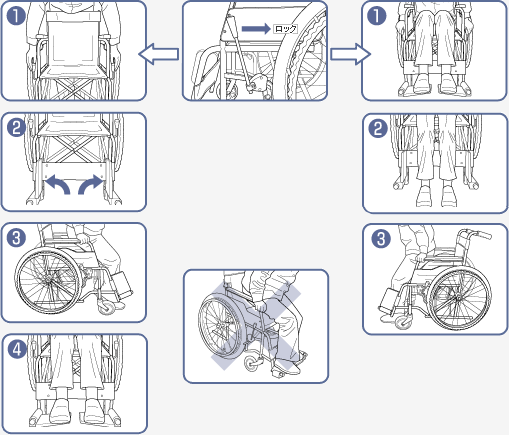
Jumping straight into adjustments can make things worse. Start by identifying the root cause.
Brakes Don’t Hold the Wheel
Likely causes:
– Worn rubber tips (replace if metal backing is exposed)
– Stretched or broken cable
– Misaligned brake pad not making full contact
Visual cue: Gap between pad and tire when brake is engaged.
Brakes Drag or Rub When Released
Cause: Over-tightened cable or misaligned caliper.
– Wheel resists rolling even when brakes are off.
– Leads to faster tire wear and harder propulsion.
Fix: Loosen tension slightly and ensure pad clears the tire completely when disengaged.
Lever Feels Loose or Spongy
Cause: Slack in the cable or loose mounting hardware.
– Test by wiggling the lever—excess movement means bolts need tightening.
– Focus on the anchor bolt and cable connection points.
One-Sided Braking
Cause: Uneven cable tension or pad alignment.
– Adjust each side independently.
– Test after each change to match engagement points.
Stiff or Sticky Movement
Cause: Dirt, rust, or dried grease in pivot joints.
– Clean with a dry cloth or degreaser.
– Apply light silicone lubricant only to moving joints—never to brake pads or tires.
Gather the Essential Tools
Most brake adjustments require minimal equipment—keep these on hand:
- 5/16″ or 10mm wrench – for jam nuts and anchor bolts
- ¼” or 5mm Allen key – common for lever screws (especially transport chairs)
- Screwdriver (Phillips or flathead) – model-dependent
- Pliers – useful for gripping small parts
- Silicone lubricant or WD-40 – for pivot points only
🔧 Note: Transport chairs often use ¼” Allen keys and 5/16″ open-end wrenches—having them ready saves time.
Adjust Brake Cable Tension Correctly
Improper tension is the most common cause of brake failure. Here’s how to fix it.
Locate Adjustment Points
Key components (usually on the right side):
– Barrel adjuster – fine-tunes tension, often near the lever
– Jam nut – locks the barrel in place
– Cable anchor bolt – secures cable at the caliper
Step-by-Step Tension Adjustment
- Loosen the jam nut with a wrench.
- Turn the barrel adjuster counterclockwise to reset (fully loosen).
- Rotate clockwise slowly until the brake pad contacts the tire.
- Engage the brake—wheel should stop instantly.
- Release brake—pad must pull away cleanly, no dragging.
- Tighten the jam nut to lock position.
⚠️ Warning: Don’t over-tighten. This can cause binding or make release difficult.
Use the Anchor Bolt Method (If No Barrel Adjuster)
Some models adjust at the caliper:
1. Loosen the cable anchor bolt.
2. Pull the cable tighter (or let it slacken) as needed.
3. Re-tighten the bolt.
4. Test engagement and release.
Make small changes—recheck after each.
Align and Position Brake Pads for Full Contact
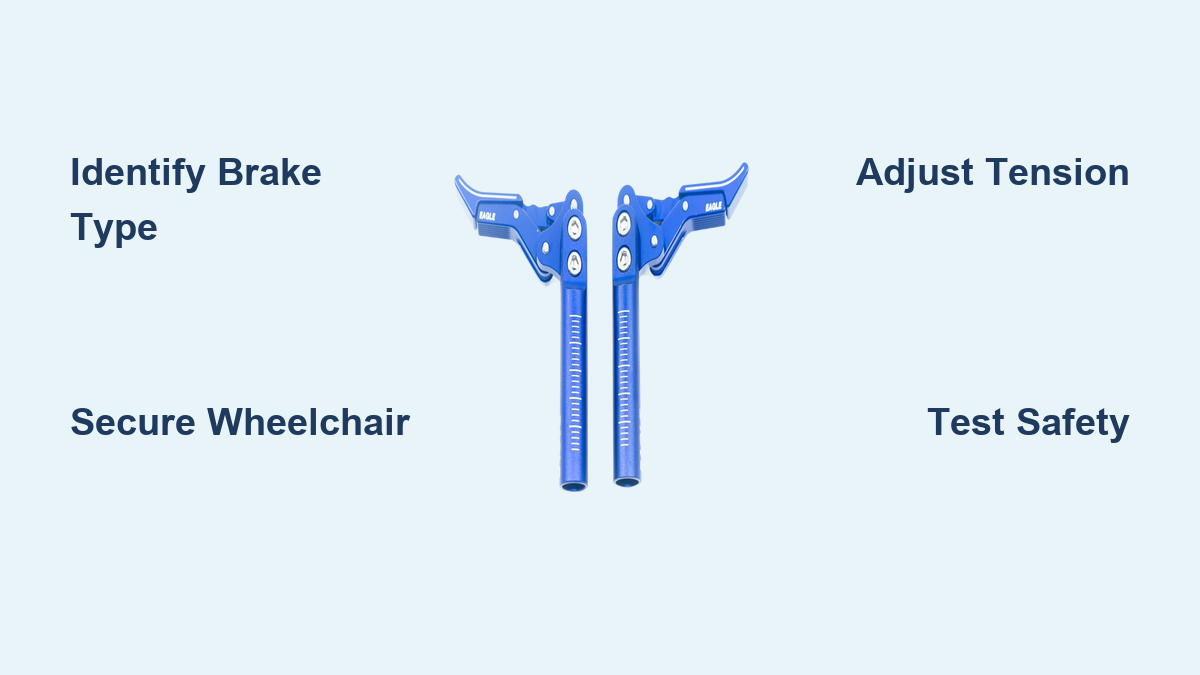
Even perfect tension won’t help if the pad isn’t aligned properly.
Check Pad Contact
With brake engaged:
– Rubber tip should press flat against the tire sidewall.
– No gaps, no edge-only contact.
If uneven, loosen the mounting screw and reposition.
Adjust Push-to-Lock Brakes
- Loosen the pad mounting screw with a screwdriver or wrench.
- Slide the pad:
– Closer to wheel = firmer, faster engagement
– Farther away = softer, delayed contact - Ensure pad doesn’t touch the rim or frame.
- Retighten screw and test.
✅ Goal: Full rubber-to-tire contact the moment the lever locks.
Replace Worn Brake Cables
When adjusting fails, the cable may be beyond repair.
Signs You Need a New Cable
- Visible fraying or kinks
- Breaks under tension
- Stretches repeatedly after adjustment
Replacement is required—don’t risk failure.
Step-by-Step Cable Swap
- Remove rear wheel (if needed) for access.
- Disconnect cable from brake lever—usually held by a bolt or clip.
- Unhook from caliper arm—pull out of anchor hole.
- Route new cable through housing—match old path exactly.
- Reattach to caliper, then secure at lever end.
- Reinstall wheel.
- Adjust tension using barrel or anchor method.
🔄 Pro Tip: Reuse old cable as a guide for routing—especially if housing is bent.
Maintain Brakes for Longevity
Prevention beats repair. Keep brakes working smoothly with routine care.
Daily Checks
- Wipe brake area clean with a dry cloth.
- Confirm levers move freely and lock securely.
- Listen for grinding or sticking sounds.
Weekly Maintenance
- Inspect rubber tips—replace if cracked, thin, or peeling.
- Check cable for kinks or rust.
- Ensure all screws and bolts are tight.
Monthly Lubrication
- Apply silicone spray or light oil to:
- Pivot points
- Lever joints
- Cable housing ends
- Avoid tires and brake pads—oil reduces friction and stopping power.
Troubleshoot Persistent Issues
Even after adjustment, problems can linger.
Brakes Still Won’t Hold
Ask:
– Are the rubber tips worn out? → Replace them.
– Is the cable broken inside housing? → Replace entire cable.
– Is the caliper bent or corroded? → Clean or replace.
Test: Manually press the brake arm against the tire. If it grips, the issue is cable tension. If not, the pad or caliper is faulty.
Lever Won’t Return
Cause: Sticky pivot or over-tightened spring.
– Disassemble lever joint, clean with degreaser.
– Lubricate pivot with silicone.
– Ensure return spring isn’t kinked or detached.
Uneven Braking
Solution:
1. Fully release both brakes.
2. Adjust left and right sides one at a time.
3. Test each side by spinning the wheel and applying brake.
4. Match resistance and stopping point.
✅ Brakes should engage at the same lever position on both sides.
Safety Tips During Adjustment
Avoid injury and damage with smart practices.
Work Safely
- Always place the wheelchair on a flat, level surface.
- Never adjust with someone seated.
- Wear gloves to protect hands from sharp edges.
Avoid Common Mistakes
- Don’t over-tighten screws—stripped threads ruin mounts.
- Don’t lube brake pads—this creates slippery hazards.
- Don’t ignore one-sided wear—leads to tipping or dragging.
Test Thoroughly
After every adjustment:
1. Engage and release 5–10 times.
2. Push the chair forward and backward with brakes on—shouldn’t move.
3. Roll freely when released—no resistance or noise.
When to Seek Professional Help
Some issues go beyond DIY fixes.
Seek a Technician If:
- Internal lever mechanism is damaged
- Frame-mounted brake brackets are bent
- Repeated adjustments fail
- You’re unsure about disassembly
Certified mobility technicians have specialized tools and training.
Consider Upgrading If:
- Your wheelchair is over 5–7 years old
- Replacement parts are obsolete
- You need easier-to-use brakes (e.g., ergonomic levers or electric options)
Modern alternatives include lightweight electric wheelchairs with automatic braking—ideal for indoor use and caregivers.
Final Checklist: Did You Adjust Correctly?
Before rolling away, confirm:
– [ ] Brakes lock wheels completely when engaged
– [ ] Wheels spin freely when released
– [ ] No dragging, rubbing, or squeaking
– [ ] Levers return smoothly to start position
– [ ] Both sides perform equally
– [ ] All screws and nuts are tightened securely
If all boxes are checked—your brakes are safe and reliable.
Final Note: Adjusting wheelchair brakes isn’t just maintenance—it’s a safety imperative. With the right knowledge, you can keep your mobility device secure, responsive, and dependable. Regular checks, proper tools, and careful adjustments empower independence. But when in doubt, consult the manufacturer’s manual or a professional. Never compromise on brake performance—your safety depends on it.